// 001
Company authority foundation
Establish the definitive factual record of the organization: services, products, locations, capabilities, history, and market position.
01 / Dominator / Local market authority
Dominator turns real organizational expertise into a clearer, more connected public record. Your people, experience, relationships, accomplishments, and useful knowledge become easier to understand and easier to find.
This is authority infrastructure for organizations that have built something real and want the public record to reflect it.
02 / What this is
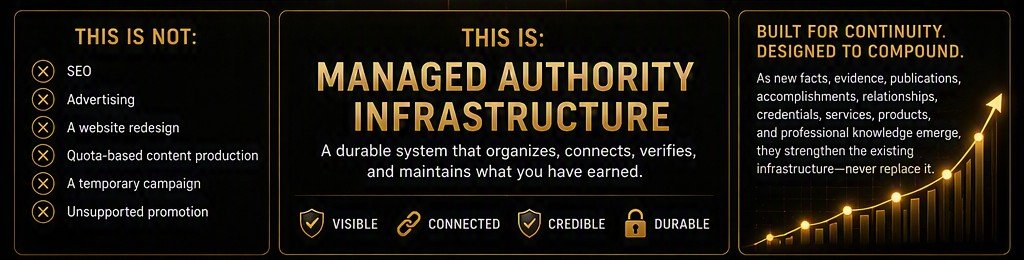
A durable system that organizes, connects, verifies, and maintains what you have earned — built for continuity, designed to compound.
03 / Operating signals
04 / The opportunity
Most businesses already possess the expertise, credibility, experience, and real-world proof necessary to become recognized authorities in their markets. The problem is that those assets are scattered across websites, resumes, certifications, project history, customer experiences, photographs, internal documents, and years of accumulated knowledge.
Dominator brings that knowledge to the surface, connects it to evidence, and develops it into a maintained authority asset that customers, partners, search platforms, software systems, and AI technologies can understand.
05 / The authority system
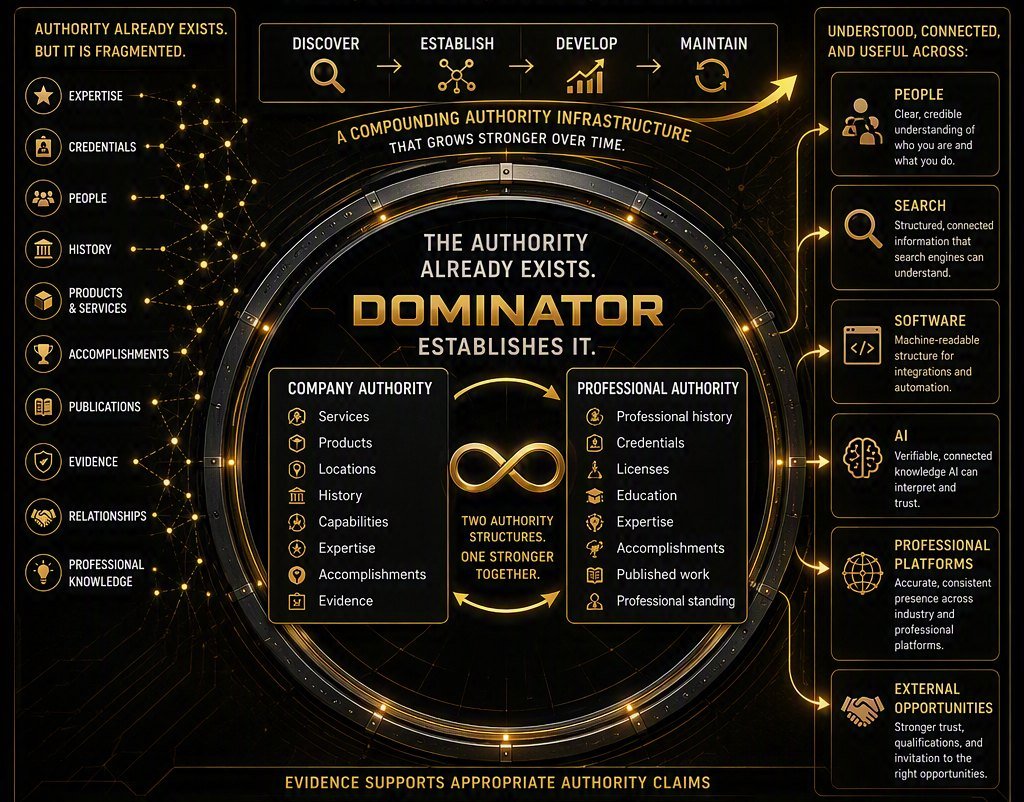
The company has authority. The professional behind it has authority. Documented separately they are two partial records; connected and maintained they become compounding infrastructure that people, search, software, AI, professional platforms, and external opportunities can all understand.
Ownership shift
Dominator connects the evidence, people, expertise, and relationships behind the business so the public record becomes an asset the organization can develop and maintain.
06 / The evidence base
Experience becomes considerably more valuable when it is connected to something verifiable. Every meaningful claim in the system is traced back to a record that already exists somewhere in the organization.


07 / 3×3 architecture
// 001
Establish the definitive factual record of the organization: services, products, locations, capabilities, history, and market position.
// 002
Document the owner, founder, physician, operator, advisor, or subject-matter expert alongside the company itself.
// 003
Connect claims to licenses, certifications, awards, memberships, publications, projects, photographs, and supporting records.
// 004
Organize the relationships between people, organizations, services, products, locations, credentials, publications, and facts.
// FOCAL
Bring forward the knowledge already present in interviews, training materials, presentations, research, projects, and recorded discussions.
// 006
Turn expertise into interviews, commentary, educational resources, research summaries, professional updates, and durable publications.
// 007
Give important services and products their own supported authority assets, contributors, evidence, differentiation, and relevance.
// 008
Maintain meaningful connections between people, organizations, credentials, services, publications, partners, and locations as the business evolves.
// 009
Support the authority system with structured data, publishing systems, integrations, measurement, knowledge organization, and ongoing maintenance.
08 / Dominator system / Begin
Dominator is a managed relationship: we document the organization, connect its evidence and expertise, develop useful public knowledge, and maintain the system as the business changes.
09 / Foundation architecture
Research, interviews, verification, evidence collection, relationship mapping, publishing, and technical implementation establish the starting record.
Existing expertise becomes professional content, service authority, research summaries, commentary, and useful public resources.
New people, services, locations, credentials, publications, and opportunities are incorporated as the organization evolves.
10 / The operating model
Dominator is intentionally a managed relationship rather than a fully automated system. Authority requires judgment, stewardship, exception handling, and accountability.
As the team learns how the business actually operates, client-specific software, automation, and operational improvements can be developed around proven processes.

11 / Core promise
The authority already exists.
Dominator establishes it.
// 11 / DOMINATOR CORE PROMISE
12 / Progressive authority
Learn how the organization actually works.
Connect claims to evidence and provenance.
Map people, services, places, and relationships.
Create useful knowledge and authority assets.
Keep the public record accurate as the business evolves.
13 / Market position
While protection remains active, Dominator does not provide the same advantage to a direct local competitor within the protected service category and geographic market. The opportunity is not simply to participate; it is to establish a position before someone else does.

14 / People / entity architecture
15 / The engagement / Managed
Dominator continues after the foundation is established. Human expertise directs the work; technology reinforces the strategy and keeps the system current.
16 / Sales partner route
Dominator can grow through appropriate professional, industry, and community relationships.
Partner route
For people who understand organizations with real expertise and can introduce the right conversation.
Working papers
Receive practitioner papers, operating notes, and product research through the dedicated document and update route.
17 / Product-relevant articles
The work behind Dominator is grounded in operations, systems, people, and the decisions that make complex organizations move.
A career-long argument for following the constraint instead of protecting the org chart.
Read article → // Operations / capacityWhat a physical limit can reveal about choreography, capacity, and network behavior.
Read article → // Supply chain / coordinationWhen sellers stopped waiting for the supply chain to fix itself.
Read article → // Software / accessAn interface barrier became a design principle: useful systems meet people where the work actually happens.
Read article →18 / The decision
The authority already exists. Dominator establishes it, develops it, and maintains it as a durable business asset.
// DOMINATOR / AUTHORITY INFRASTRUCTURE